Choosing between slim and ultra-thin downlights can change more than a ceiling’s appearance. It affects installation depth, heat management, brightness, maintenance, and long-term reliability. In China’s lighting market, both options are widely available, but product quality varies between factories, models, and price levels. A lower price does not always mean better value.
A practical question guides this comparison: What is the difference between slim and ultra-thin downlights? Slim downlights usually have a shallow housing, while ultra-thin models use an even narrower body for tight ceiling spaces. This difference may appear small on a specification sheet. It becomes important when the ceiling cavity is limited to only a few centimeters. An electrician may also notice differences in driver placement, spring clips, wiring space, and heat dissipation.
Real project experience shows that brightness alone cannot decide the best choice. A kitchen may need stable, glare-controlled light, while a hotel corridor may prioritize a clean appearance and easy replacement. Check the LED chip, driver brand, color consistency, beam angle, IP rating, and warranty terms. Ask for photometric data and sample testing before placing a large order. Certifications should be verified, not simply printed on a product label.
Ultra-thin is not automatically superior. Sometimes, its compact body leaves less room for thermal control. That can affect performance in hot ceilings or long operating hours. This point is often overlooked. Slim models may provide a more balanced structure, but they need deeper installation space. The right decision depends on the ceiling, lighting plan, budget, and supplier credibility. Even experienced buyers can miss one detail. Careful comparison remains essential.
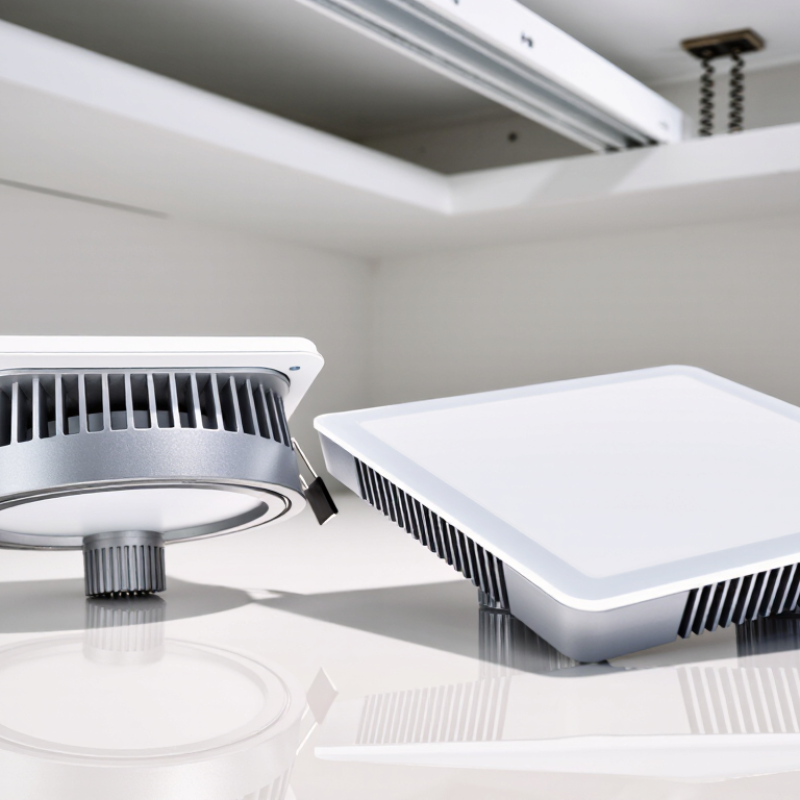
What Defines Slim and Ultra-Thin Downlights: 50–70 mm vs 25–40 mm Profiles
China Best Slim vs Ultra Thin Downlights: Which Is Better?
Slim and ultra-thin downlights are not identical products. A slim model usually has a 50–70 mm profile, while an ultra-thin model measures about 25–40 mm. That difference matters inside shallow ceilings, concrete slabs, and insulated joists. A 30 mm body can avoid cutting a deeper cavity. It also reduces installation pressure.
Depth changes everything. The U.S. Department of Energy’s 2023 Solid-State Lighting R&D Opportunities report identifies thermal management as a major LED reliability factor. In practice, a 50–70 mm housing often provides more room for heat dissipation and a larger driver. This can support stable output, lower color shift, and longer service life. Ultra-thin designs remain useful where space is severely limited, but their compact heat path demands closer engineering review.
Light quality still decides the purchase. DOE’s LED Lighting Facts database has shown listed recessed products commonly ranging around 70–120 lumens per watt, depending on output and design. Higher efficacy does not automatically mean better comfort. Check tested lumens, glare control, color rendering, and driver performance under insulation. ENERGY STAR testing also emphasizes efficacy, lifetime, color quality, and standby power. The label is not enough. I would not call ultra-thin automatically better; that assumption is too neat. For open ceilings, slim often offers more thermal margin. For restricted cavities, ultra-thin may be the practical answer.
How 80–120 lm/W Efficacy Affects Light Output and Energy Use
When comparing slim and ultra-thin downlights, efficiency deserves more attention than housing depth. Efficacy measures delivered lumens per watt. A 10-watt light rated at 80 lm/W produces about 800 lumens, while one rated at 120 lm/W can reach 1,200 lumens. That difference affects brightness, operating cost, and the number of fittings needed.
For a similar 1,000-lumen target, an 80 lm/W downlight uses roughly 12.5 watts. A 120 lm/W model needs about 8.3 watts. In a hallway with twenty fittings, the higher-efficacy option could reduce connected load by approximately 84 watts. The saving becomes more meaningful when lights operate for many hours each day. Still, efficiency figures are not the whole story. Diffusers, beam angles, glare control, and ceiling color can change perceived brightness.
In practical installations, ultra-thin designs may suit shallow ceilings, but limited space can restrict heat dissipation. Heat may reduce real output over time. I would check the photometric report, not only the product label. Look for tested lumens, power consumption, color rendering, and operating temperature. A light claiming 120 lm/W may achieve that figure under ideal laboratory conditions. Actual performance can be lower. This is easy to overlook. For balanced lighting, a dependable 90–110 lm/W fixture may sometimes perform better than a higher-rated model with harsh glare or poor thermal management.
How CRI ≥80, R9 ≥50, and 2700–6500K CCT Shape Lighting Quality
China Best Slim vs Ultra Thin Downlights: Which Is Better?
For downlights, slim and ultra-thin designs can both look clean. Their lighting quality depends more on optical control, heat management, and color specifications. CRI ≥80 is a practical baseline for homes and commercial spaces. It measures average color fidelity, but it can hide weak red rendering. R9 ≥50 helps reveal skin tones, wood, food, and artwork more naturally. CIE 13.3 and IES TM-30-20 support evaluating color quality beyond one number. That matters.
A 2700–6500K CCT range supports warm bedrooms, neutral kitchens, and cool work areas. However, a wide range does not guarantee consistent color. Poor drivers may create visible shifts between fixtures. The U.S. Department of Energy’s solid-state lighting reports repeatedly identify thermal control, optics, and color consistency as key performance factors. In field installations, ultra-thin units often simplify ceiling access. Slim units may offer deeper heat sinks and better glare control. Neither design always wins. My judgment remains cautious here.
Tips: Request test reports showing CRI, R9, CCT tolerance, flicker, and lumen maintenance. Check several fixtures together at 2700K and 4000K. Look at red fabric, skin, and white paper. A small sample can expose uneven color. Also review IES files and LM-80 data, not only the product label. Specifications can look excellent on paper, yet the room may still feel harsh.
Which Installation Fits Best: IC Rating, 90–120 mm Cutouts, and IEC 60598
Choosing between slim and ultra-thin downlights depends less on appearance than installation conditions. A 90–120 mm cutout must match the measured hole, not the advertised size. Slim models usually offer deeper heat sinks and more space for thermal management. Ultra-thin models suit shallow ceilings, but their remote drivers may require accessible, ventilated locations. I have seen installers overlook this detail.
An IC-rated luminaire can contact insulation, but the rating must appear on the product certification. It does not automatically confirm safe installation in every ceiling type. Verify insulation depth, airflow, junction-box clearance, and local electrical requirements. IEC 60598-1 addresses luminaire safety, including insulation, temperature, wiring, and mechanical protection. However, IEC compliance is not identical to North American IC classification.
Performance also deserves attention. The U.S. Department of Energy’s 2023 Solid-State Lighting report places many commercial LED luminaires near 100–150 lumens per watt, while heat can reduce practical output. Ultra-thin construction may increase thermal stress. A lower profile is not always better. The International Energy Agency continues to identify efficient lighting as a major electricity-saving opportunity, yet poor installation wastes that advantage. For a 90 mm opening, measure the ceiling cavity first. For 120 mm openings, compare trim coverage, driver access, and insulation contact. The best choice may be the less fashionable one.
How 8–15W Residential and 18–24W Commercial Needs Guide Selection
China Best Slim vs Ultra Thin Downlights: Which Is Better?
Choosing between slim and ultra-thin downlights depends on wattage, ceiling depth, and installation conditions. For residential rooms, 8–15W models usually provide enough light for bedrooms, hallways, kitchens, and small living areas. Ultra-thin downlights suit shallow ceilings and renovation projects, where limited space makes installation easier. However, their compact housing may reduce heat dissipation. Check lumen output, beam angle, color temperature, cutout size, and driver quality instead of trusting wattage alone. A 12W light with poor efficiency may perform worse than a reliable 10W model.
Commercial spaces often need 18–24W downlights for stronger illumination and longer operating hours. Slim designs can offer better thermal space, easier maintenance, and more stable performance in offices, shops, and corridors. Ultra-thin products may still work when ceiling depth is restricted, but ventilation deserves attention. In practical projects, uneven brightness often comes from poor spacing, not insufficient wattage. That detail is easy to miss.
Tips: Match 8–15W with room size and ceiling height. For 18–24W commercial use, confirm heat management and continuous-duty testing. Compare real lumens, not watts only. Ask for photometric data and installation samples. I would also test one fitting before ordering in bulk. Specifications can look perfect on paper, yet the finished ceiling may feel too bright, too dim, or visually flat.
FAQS
Slim downlights usually measure 50–70 mm deep. Ultra-thin models usually measure 25–40 mm. The difference affects ceiling cutting and heat management.
Choose one for shallow ceilings, concrete slabs, or insulated joists. A 30 mm body may fit without creating a deeper cavity. Measure twice.
Its deeper housing usually leaves more room for heat dissipation. It may also accommodate a larger driver. This can support steadier output and lower color shift.
No. Their compact design solves space problems, but heat has less room to escape. I would not treat thinness as proof of quality. That assumption is too simple.
Residential rooms commonly use 8–15W models. Bedrooms, hallways, kitchens, and small living areas may fit this range. Check actual lumens, not wattage alone.
Offices, shops, and corridors often need 18–24W downlights. Longer operating hours make heat control more important. Continuous-duty testing deserves attention.
Compare tested lumens, beam angle, color temperature, color rendering, cutout size, and driver quality. Photometric data can reveal uneven coverage. Wattage alone misleads.
Review spacing, ceiling height, and beam angle together. Uneven brightness often comes from poor spacing, not low wattage. Test one fitting first. Paper specifications may still disappoint.
Conclusion
Choosing between slim and ultra-thin downlights depends on ceiling space, lighting performance, and installation requirements. What is the difference between slim and ultra-thin downlights? Slim models typically have 50–70 mm profiles, while ultra-thin versions are around 25–40 mm, making them more suitable for shallow ceilings or limited installation depth. Both types can deliver approximately 80–120 lm/W, but the ideal wattage depends on the application: 8–15W is generally suitable for residential rooms, while commercial spaces may require 18–24W for stronger and wider illumination.
Lighting quality also depends on CRI and color temperature. A CRI of at least 80 supports natural-looking colors, while R9 of 50 or higher improves the rendering of red tones. Adjustable CCT from 2700K to 6500K provides flexibility from warm, relaxing light to cool, task-oriented illumination. Before installation, verify IC rating, ceiling cutouts of approximately 90–120 mm, and compliance with IEC 60598. Overall, ultra-thin downlights offer easier fitting, while slim designs may provide greater structural depth and application flexibility.

 Diva Lights